










 Español

For decades, industrial robots excelled at one thing: executing precisely what they had been programmed to do. They followed fixed trajectories, repeated the same movements, and operated within tightly controlled environments.
That model is evolving. Advances in artificial intelligence, computer vision, sensors, simulation, and edge computing are enabling machines to perceive their surroundings, make decisions, and act in the physical world.
This is the foundation of physical AI. The concept extends beyond adding an AI model to a robot. Its real significance lies in how it changes the relationship between machines and the environments in which they operate.
What is physical AI?
Physical AI applies artificial intelligence to systems that perceive, reason, and act in the real world.
Unlike a generative AI application that processes text or images in a digital environment, a physical AI system receives information through sensors, interprets the context, decides what to do, and translates that decision into a physical action.
The cycle can be summarized in five steps:
Perceive → Interpret → Decide → Act → Adapt
That cycle can involve cameras, depth sensors, motors, actuators, and AI models running locally. Physical AI therefore extends well beyond humanoid robots. It can be embedded in industrial arms, autonomous vehicles, inspection drones, agricultural machinery, and advanced logistics systems.
Is physical AI the same as robotics?
No. Robotics predates physical AI by decades. Industry has long used machines built with sensors, motors, control systems, and, more recently, computer vision.
The distinction lies in the level of perception, autonomy, and adaptation a system can achieve. A conventional robot may execute a defined sequence under known conditions. A physical AI system can interpret changes in its environment and adjust its behavior when conditions differ from what was expected.
Physical AI is best understood as an expansion of the capabilities available to robots and other autonomous machines.
How does physical AI differ from traditional automation?
Traditional automation typically begins with a programmed trajectory. The environment, object, and position are known, and the system follows predefined instructions.
Physical AI often begins with a goal. The system then uses perception and planning to determine how to pursue it within defined operating limits.
| Traditional automation | Physical AI |
|---|---|
| A sequence is programmed | A goal and operating constraints are defined |
| The environment is tightly controlled | The environment can contain manageable variability |
| Rules and trajectories are predefined | Perception informs planning and decisions |
| The system executes | The system perceives, plans, and acts |
| Changes can interrupt the process | Some variation can be absorbed by the system |
| The environment is adapted to the robot | The machine can adapt to parts of the environment |
Traditional automation will remain the most efficient option for many stable, repetitive, and predictable processes. The value of physical AI increases when variability becomes operationally significant.
Consider a robot that places the same part in the same position thousands of times. A conventional automation system may be ideal. If those parts arrive at different angles, the lighting changes, or an unexpected object enters the workspace, the system needs perception and decision-making capabilities to continue safely. Those are the conditions in which physical AI becomes relevant.
Why is physical AI emerging now?
Robots have operated in factories for decades. The recent shift comes less from a breakthrough in mechanics than from improvements in how machines perceive and process information.
Three developments are particularly important:
- Simulation has expanded the range of training scenarios. Developers can test systems in virtual environments before placing equipment, products, or people at risk. Synthetic data can also expose a model to variations that would be costly or difficult to reproduce physically.
- Computing has moved closer to the machine. Edge processing reduces dependence on a constant cloud connection and can support the low-latency decisions that physical operations require.
- Models can handle more variability. With appropriate training and safeguards, perception and planning systems can respond to changes in object position, lighting, or surrounding conditions without relying on a separate rule for every scenario.
These developments are expanding the role of robotics in industrial operations. A World Economic Forum white paper on physical AI connects that shift with the need for greater flexibility and resilience in increasingly complex operating environments.
How does physical AI work?
The architecture varies by application, but most physical AI systems combine four functional layers.
1. Perception
The system must build a usable representation of its environment. Cameras, depth sensors, LiDAR, motion detectors, and sensors for temperature or pressure can all contribute data.
Computer vision is especially important when the system must detect objects, people, anomalies, positions, or changes. The quality of that perception sets an upper limit on the quality of the decisions that follow.
2. Intelligence and decision-making
Sensor data must be converted into an operational decision. Depending on the application, the system may classify what it sees, estimate position, predict movement, select an action, or plan a path. This layer also needs constraints that define which actions are permitted and when human intervention is required.
3. Action
The decision is translated into a physical response. That may involve moving a robotic arm, changing a vehicle’s trajectory, adjusting a machine setting, triggering an alert, or sending instructions to another system.
4. Adaptation and recovery
A physical AI system must account for situations that do not exactly match its expected conditions. Adaptation can involve recalculating a route, repositioning a tool, slowing an operation, or transferring control to a person. In safety-critical settings, knowing when to stop is as important as knowing how to proceed.
What technologies enable physical AI?
Physical AI does not depend on a single technology. It combines several layers:
- Artificial intelligence and machine learning
- Computer vision
- Sensors and actuators
- Robotics and control systems
- Edge computing
- Simulation and synthetic data
- Digital twins and world models
- Data infrastructure
The robot or machine is the visible endpoint of a broader system. Its performance depends on the quality of the data, models, controls, integrations, and operational processes behind it.
Physical AI in action: four real-world examples
Physical AI is already changing how machines operate in environments where conditions cannot be controlled completely.
- Precision agriculture: John Deere’s See & Spray technology uses computer vision to distinguish weeds from crops and spray only the targeted plants. Across more than five million acres, operators reduced their use of non-residual herbicide by an average of nearly 50%, according to company data published in 2025.
- Autonomous inspection: Drones and mobile robots can capture images, detect anomalies, and redirect attention toward equipment or infrastructure that may require closer inspection. The operational value comes from combining perception with a response workflow, rather than from image capture alone.
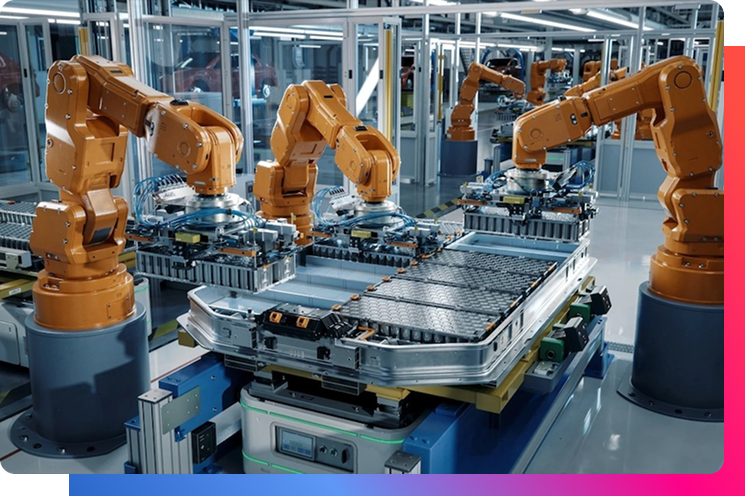
- Adaptive manufacturing: A vision-guided robotic arm can locate a part that arrives at an unexpected angle and adjust its movement within an approved range. This can reduce stoppages without removing the controls needed to protect workers and equipment.
- Mining and infrastructure: Vision systems can classify materials, monitor safety zones, and identify signs of wear. When connected to maintenance and operations systems, those observations can help teams prioritize interventions before a defect becomes a failure.
What challenges does physical AI face?
The physical world is less predictable than a digital environment, and the consequences of error are different. A machine that interacts with people, products, vehicles, or infrastructure can cause physical or financial harm if it perceives a situation incorrectly or takes the wrong action.
Accuracy alone is therefore insufficient. Physical AI systems must also address:
- Safety
- Latency
- Reliability and availability
- Error recovery
- Systems integration
- Data quality
- Governance
- Human oversight
These requirements are interdependent. A highly accurate model may still be unsuitable if it responds too slowly, cannot explain an exception, or lacks a safe fallback. The same applies to data: Microsoft identifies quality, secure accessibility, and governance as core dimensions of AI-ready data. In physical systems, weaknesses in those areas can affect both model performance and operational control.
How can you tell whether a process is ready for physical AI?
The assessment should begin with the process, not the technology. Three questions can help determine whether physical AI is appropriate.
1. Which tasks combine repetition with manageable variability?
A task may be difficult to automate with fixed rules if objects, positions, or environmental conditions change. When the task recurs frequently and that variability falls within definable limits, physical AI may create a meaningful opportunity.
2. Where does human availability constrain the process?
Some operations depend on people being continuously available for remote, dangerous, or highly repetitive work. Physical AI can be valuable when it extends human capacity while keeping people responsible for supervision and exceptions.
3. Can the system fail safely?
A viable design must account for what happens when perception is uncertain, connectivity is lost, or an action cannot be completed. The system needs a safe state, a recovery path, and clear conditions for human intervention.
From automation opportunity to operating decision
Physical AI expands the range of processes that machines can support, especially where repetition and variability coexist. Its value does not come from autonomy alone. It comes from combining perception, decision-making, action, and recovery within clearly defined operational limits.
The practical question for an organization is therefore not whether a robot can perform a task in ideal conditions. It is whether the complete system can perform that task reliably, integrate with existing operations, and respond safely when reality differs from the plan.